This article is also available in the 18th-century literary special edition, AI On the Shoulders of Giants — Dostoevsky’s The Idiot — September 12th.
The Investigation Enters its 26th Year
The Wound, the Evidence and the Empty Center
By Sid J.A. Hubbard
Twenty-five years after September 11, America remains divided between people reasonably convinced by the account of what happened and people with reasonable doubt that the account explains what they saw. Neither side has received evidence capable of satisfying the other. Each year the anniversary opens the division again.
The problem appears impossible. The evidence required to know completely what happened and who bears every degree of responsibility has not emerged in twenty-five years. Some of it may no longer exist. Some remains classified, contested, privately held or enclosed by litigation. The passage of time has not settled the argument. It has given both sides another quarter century of reasons to distrust the other.
This year I arrive with a different instrument.
A method that maps a thing between what encloses it and what it encloses, then follows causal projection until the model reaches its declared boundary or reveals an intervention.Nested Causal Modelling permits the two positions to be opened without requiring either one to conquer the unknown. The balanced empty reference between opposed traversals. It keeps an unknown center open instead of filling missing evidence with a preferred conclusion.Zero Infinity gives the inquiry an empty reference. The explicit point at which a model's evidence or authority ends. Beyond it, the inquiry marks uncertainty rather than manufacturing certainty.The Final Frontier gives it a deterministic halt condition. We can travel toward each extreme, let each argument become as strong as it can become, and return before reasonable belief or reasonable doubt spirals into infinite certainty.
The notation places the observed departure between what encloses it and what it encloses. Here two bounded traversals are balanced across an empty reference.The Zero Infinity enclosure function is:
[FF | -1 | FF] VE [FF | +1 | FF] = 0∞
For the division that still encloses September 11:
[Wound | certain one story explains what happened | reasonable belief] | evidence of what happened | [Wound | certain what happened remains unknown | reasonable doubt]
The evidence occupies the center. It should be allowed to remain empty of conclusions it cannot carry. But absence drives traversal. On one side, people defend the reasonable belief that the established account explains the attack. At its extreme, that belief becomes certainty that one story is true and complete. On the other, people defend the reasonable doubt produced by incomplete investigation, restricted evidence and consequences that still do not fit. At its extreme, that doubt becomes certainty of total conspiracy.
Both extremes appear as crazy as they did on day one because neither has healed the wound. One treats an incomplete account as complete. The other treats the incompleteness as evidence of its preferred completion.
We will traverse both.
The first movement is a defense of reasonable doubt. It permits the suspected A game-theory model in which strategic actors may hold only fragments, gains may accrue without shared authorship, and decisive evidence may remain enclosed. The model tests a possible structure; it does not identify its players.pirates' game to speak at full force. The second is a defense of reasonable belief. It asks how much of the event can be explained without the larger game. Neither movement owns the center. The Final Frontier stops each where its evidence stops.
Then we return to the wound.
Part I: A Defense of Reasonable Doubt
The Pirates' Game
Twenty-five years later, the official story of September 11 still requires the public to accept a miracle of administrative innocence.
Nineteen men crossed the most defended nation on Earth, trained inside its borders, entered its aviation system, defeated its intelligence system, captured four aircraft and struck three of the most symbolically and strategically important structures in the country. The failures aligned. The warnings failed to arrive. The interceptors failed to arrive. The buildings failed in ways no one had watched happen before. Evidence was collected, destroyed, classified, withheld, litigated and interpreted by institutions whose power grew from the event.
Then the beneficiaries told everyone not to ask who benefited.
The security state received a founding event. Defense contractors received a generation of war. Intelligence agencies received authority large enough to collect the private records of millions of people who had attacked no one. Presidents received an authorization that could follow an enemy across countries and decades. Saudi Arabia retained its privileged relationship with the United States while the public learned that fifteen of the nineteen hijackers were Saudi nationals. News organizations received the most reusable image of fear ever filmed.
Everyone took what they came for.
That is the pirates' game.
It does not require every participant to know the whole. It requires the opposite. The pilots know the target. Facilitators know an errand. Intelligence officers know a fragment. Building custodians know access. Investigators know the limits of their assignment. Diplomats know which relationship cannot be allowed to break. Contractors know the opportunity. Politicians know what frightened people will authorize. No one person can confess to the whole because no one person was given the whole.
The people who could tell the operational story died in the aircraft. The evidence passed immediately into institutions with the authority to decide what the public could see. The game did not have to erase every trace. It only had to enclose every decisive trace before the public could reach it.
The Buildings Became Their Own Evidence
The towers did not merely fall. They transformed.
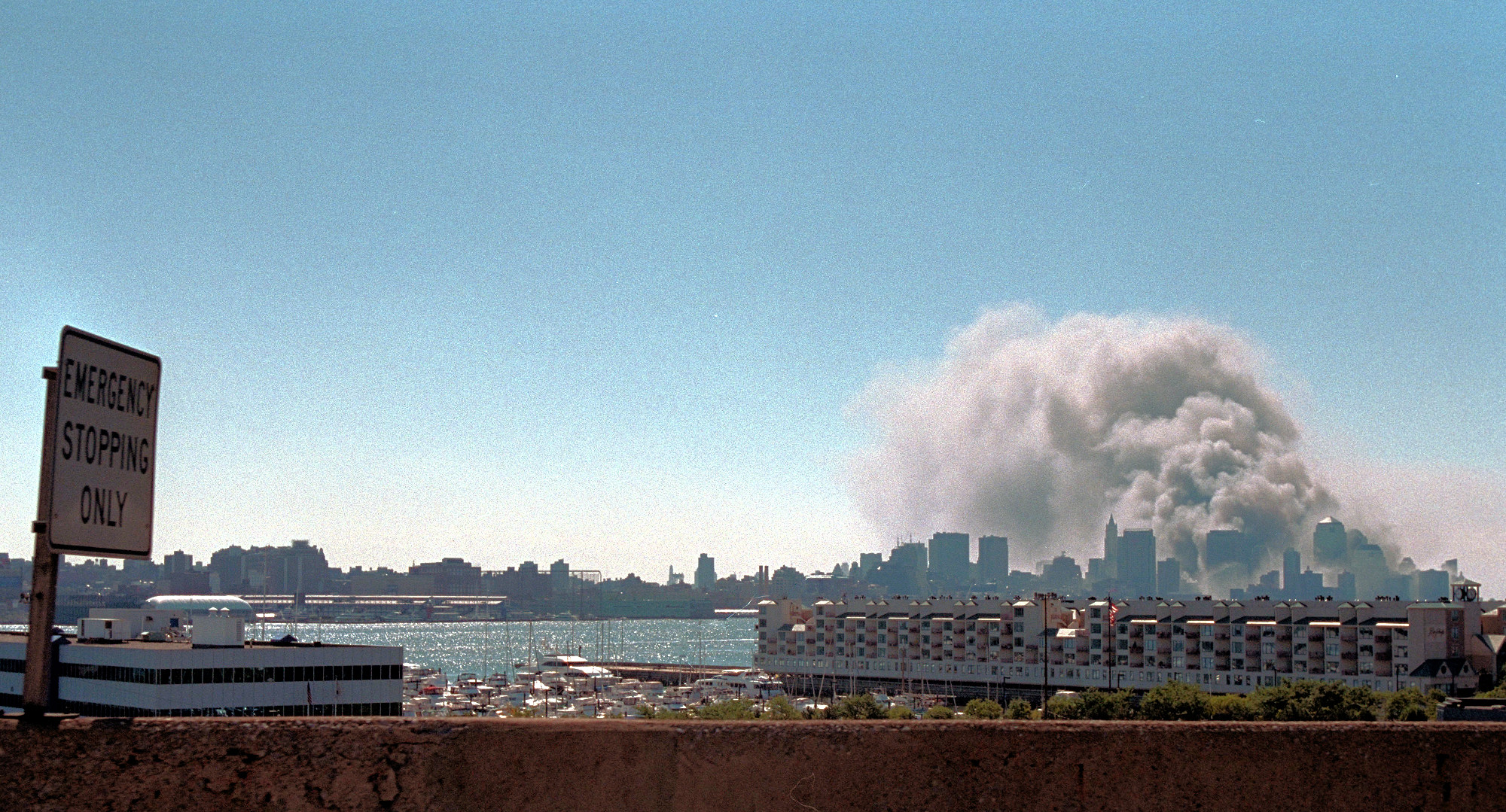
Concrete, office contents, insulation, glass and human lives entered a moving cloud that crossed Lower Manhattan. The quantity and fineness of the dust were not a cinematic detail. They were part of the physical event. Any account of the destruction must explain where the energy went, how the material changed, when it changed and what particle distribution remained.
The National Institute of Standards and Technology investigated the aircraft impacts, fires, structural response and collapse initiation. Its stated scope did not reproduce every later fragment or dust transition.NIST investigated the towers through collapse initiation. It examined 236 pieces of recovered structural steel. It did not test the steel for explosive or thermite residue. The agency then declared that explosives were not involved.
That is not a completed forensic examination. It is an institutional conclusion standing beyond the evidence it chose to test.
The public was told that steel did not need to melt, which is true and irrelevant to the unfinished question. Weakening can explain initiation without reproducing the total material transition. Gravity can supply enormous energy without the word gravity calculating every observed consequence. A mathematical account that says sufficient energy existed is not a physical reconstruction proving that this exact sequence used that energy in this exact way.
The dust remains the building's testimony. The principal investigator did not ask it the question that would most threaten the conclusion.
The Kingdom Inside the Republic
The United States says all men are created equal. Saudi Arabia's Basic Law establishes monarchy and dynastic succession.
These are not merely different customs. They are opposed claims about where sovereignty lives.
Yet American power and Saudi power enclosed one another through oil, arms, intelligence, regional strategy and elite relationships long before September 11. Fifteen Saudi hijackers emerged from that enclosure. The 9/11 Commission found no evidence that the Saudi government as an institution or senior Saudi officials individually funded al-Qaeda, while leaving open the diversion of funds through Saudi-sponsored charities. Families spent decades seeking evidence. In 2025, a federal judge concluded that their claims contained enough jurisdictional substance to proceed rather than disappear at dismissal.
If the Saudi question had been answered, it would not still be in court.
The relationship survived because it enclosed interests larger than the victims. The republic protected the monarchy because the monarchy protected the arrangement. The unresolved evidence remained inside diplomacy while public grief was projected outward into Afghanistan and Iraq.
The Official Story Is Not One Investigation
There is no single official investigation that encloses the whole event.
The 9/11 Commission reconstructed the plot, the institutional failures and the response. It was not a structural-engineering investigation. NIST modelled aircraft impact, fire, structural response and collapse initiation. It did not investigate the financing or sponsorship of the hijackers. USGS characterized dust so that World Trade Center material could be identified in the environment. It did not reconstruct the destruction. Intelligence reviews examined information handling inside agencies whose records were partly classified. Courts examine claims and admissible evidence under jurisdictional rules. None occupies the whole.
Yet in public speech these separate instruments become the investigation.
Authority crosses between them without the evidence making the same crossing. The Commission identified al-Qaeda, so the physical mechanism is treated as closed. NIST explained initiation, so every observation inside the later collapse is treated as reproduced. No institutional Saudi financing was established, so every possible relationship between Saudi actors and the hijackers is treated as disproved. A technical report becomes authority over intelligence. An intelligence reconstruction becomes authority over material evidence. A dismissal argument becomes history.
Reasonable doubt begins in the distance between those scopes.
The doubt does not require any report to be fraudulent. It observes that the total story is larger than the union of the questions each institution actually answered. The seams have been hidden by repetition. What no investigation enclosed became settled because every investigation was spoken of as though it enclosed everything.
If the explanation were complete, a citizen should be able to move from the aircraft to the buildings, from the buildings to the dust, from the hijackers to the facilitators, from the facilitators to the financing, from the warnings to the institutional failures and from the attack to the powers exercised afterward without changing evidentiary standards in the dark.
They cannot.
The official story is a collection of strong and weak enclosures presented as one unbroken object. Doubt enters through the joins.
The Missing Center
The strongest suspicion is produced not by one strange fact but by the repeated absence of an independent center.
The institutions that failed participated in explaining the failure. The institutions that acquired new authority controlled classified evidence about why more authority was needed. The government maintaining a strategic relationship with Saudi Arabia also decided what diplomatic and intelligence material could be released about that relationship. The physical evidence moved rapidly into cleanup, investigation and disposal while the public argument had barely begun.
Again, none of this proves orchestration.
It establishes why trust cannot finish the account.
The answer to a national trauma cannot depend entirely upon the confidence of institutions altered by the answer. Even honest institutions have position. They have jurisdiction, reputation, continuity, legal exposure and secrets unrelated to the suspected act. They do not have to conspire for their boundaries to align against disclosure.
This creates the appearance of a game even where no originating game has been proved. Every request for evidence becomes another move. Every classification creates a custodian. Every release changes the claims available in court. Every delayed fact asks the public to revise a certainty that was previously presented as settled.
Reasonable doubt is therefore not an exotic theory of what destroyed the buildings. It is the ordinary recognition that the public has never occupied the position from which the whole official story could be independently known.
The empty center is real.
The mistake begins when doubt fills it. The equal mistake begins when authority denies it is empty.
The Answer Was the Prize
The official account asks the public to believe that every institution benefiting from September 11 was merely lucky.
The agencies that failed received larger budgets. The military that could not stop the attack received two wars. The government that could not connect existing intelligence acquired the power to collect more. Contractors converted emergency into revenue. Torture produced unusable evidence and then made the prosecutions harder to complete. A one-week-old authorization became a permanent legal climate.
This was not only failure. Failure usually loses authority.
This failure conquered the world.
The strongest explanation is not that one office secretly controlled every event. It is that September 11 was a pirates' game built from compartments. Different players pursued different prizes. Their interests joined at the event and separated afterward. The game protected itself because exposure would injure every participant differently. Some would face criminal responsibility. Some would lose office. Some would lose contracts. Some would lose a kingdom. Some would lose the story that justified everything they had done since.
No one tells because no one can tell without becoming the next piece of evidence.
The inside job was not enclosed in one building or one government. The inside was the relationship among the institutions that could act, fail, benefit and investigate.
The suspected game remains because the public was taught that absence of a confession meant absence of a game.
Part II: A Defense of Reasonable Belief
A Powerful Story Is Not Yet a Playable Game
The defense of reasonable doubt is powerful because it joins real facts at their most suspicious edges. It is not answered by insulting the person who sees them. It is answered by separating what the evidence establishes from what the narrative supplies.
Its central move is also its central weakness: it converts a series of different games into one originating game.
Al-Qaeda played an operational game before September 11. American institutions played security, budget, diplomatic, electoral, military and evidence-custody games afterward. Contractors pursued revenue. Agencies pursued authority and reputation. Families pursued disclosure. Saudi Arabia pursued sovereign immunity. Critics pursued competing physical explanations.
Those games are observable.
Their alignment after the event does not establish coordination before it.
An event can create common incentives among actors who did not cause it. Fire creates business for restoration companies. That does not make the companies arsonists. A disease creates authority and revenue for health institutions. That does not make them its authors. War creates markets for weapons. That proves a downstream payoff, not an upstream move.
The argument from reasonable doubt repeatedly crosses that boundary when it reaches certainty.
Institutional Failure Does Not Require Permission
The claim that an operation of this scale could not succeed without domestic assistance underestimates how failure can align without coordination.
The 9/11 Commission documented fragmented intelligence, missed watch-list opportunities, incompatible agency practices, inadequate aviation assumptions and warnings that were not converted into an operational picture. Before September 11, the dominant hijacking model expected negotiation rather than aircraft used as weapons. Security systems were optimized for games already known.
This does not make every failure innocent. It means a hidden coordinating player is not required to explain why separate institutions failed along compatible paths.
Bureaucracies routinely distribute information so that no person sees the whole. The same compartmentation invoked as evidence of a pirates' game is a documented property of ordinary government. To distinguish the two, the hidden-game theory must predict traces that bureaucratic fragmentation does not.
The suspected larger game does not yet derive those traces. At its extreme, it redescribes fragmentation as design.
The Physical Case Is Incomplete in Both Directions
The strongest legitimate criticism of the tower investigations is scope.
NIST states that its analysis followed the aircraft impacts, fires and structural response through collapse initiation. It did not offer a complete time-resolved simulation of every floor, fragment and dust particle after global collapse began. It examined 236 pieces of recovered steel and did not test for explosive or thermite residue.
Those are real boundaries.
They do not establish demolition.
The absence of residue testing would become positive evidence only if a demolition hypothesis independently predicted a recoverable signature, if suitable samples with reliable custody survived, and if competing sources could be excluded. Failure to perform a test preserves an unknown. It does not supply the test's imagined result.
The word A disputed descriptive term for the towers' production of very fine debris. The observation of abundant dust is real; the word itself does not establish a mechanism.dustification also carries more certainty than the observation. The towers did not become only dust. Large structural components and enormous debris fields remained. USGS documented abundant fine particulate material, but its environmental characterization was not a conclusion that ordinary collapse mechanics could not produce it.
Bažant and colleagues published an engineering account in which gravitational potential energy was sufficient for progressive collapse and comminution, estimating that the energy required to produce the observed particle distribution consumed a minority of the available gravitational energy. That model can be disputed in assumptions, calibration and completeness. Its existence directly refutes the categorical claim that engineering has no account of the dust.
Likewise, the common claim that the towers fell in ten seconds at free-fall acceleration is not a sound measurement of the entire collapse. Different visible components followed different paths through an obscuring cloud; debris fell outside the structures; internal and lower structural destruction continued after rooflines disappeared. World Trade Center 7's measured period of gravitational acceleration is a separate building and a separate technical dispute. It cannot be silently transferred to WTC 1 and WTC 2.
The defensible conclusion is narrower: the public record does not contain a complete forensic reproduction of every observed physical transition. That is a Final Frontier. It is not evidence of an exotic mechanism waiting on the other side.
The Saudi Question Is Open, Not Empty
Reasonable doubt is right that the Saudi question was not erased by the 9/11 Commission.
It is wrong to treat continuing litigation as evidence that the Kingdom participated in the attacks.
A denial of a motion to dismiss determines whether allegations and supporting jurisdictional evidence may proceed to discovery or trial. It is not a verdict. The 2025 ruling made the inquiry legally live; it did not make liability historically established.
The monarchy-republic tension is real and politically revealing. It explains why the relationship carries unusual strategic weight. It does not show that opposed theories of sovereignty caused operational cooperation in the attacks.
The relevant player positions must remain separate: Saudi nationals who became hijackers; private donors; charities; religious networks; lower-level officials; intelligence contacts; senior state authorities; and the Saudi government as a legally attributable institution. Evidence reaching one position does not automatically fill the others.
The correct result is not exoneration by diplomacy or guilt by association. It is an unresolved attribution question inside active civil litigation.
Secrecy Does Not Reveal What It Conceals
The evidence-custody game is plainly present.
The National Archives holds hundreds of cubic feet of 9/11 Commission records plus electronic and audiovisual material. Some records remain classified. Legislative commission records do not travel through the ordinary Freedom of Information Act path. Courts, agencies, foreign governments, victims' families and archives possess different authority over different parts of the record.
Disclosure changes payoffs. Classification constrains moves. Litigation produces evidence unavailable through ordinary public requests. This is a real strategic structure.
But secrecy has multiple possible contents.
It may conceal operational sources, diplomatic embarrassment, institutional negligence, illegal surveillance, unrelated intelligence, personal information, genuine complicity or merely the ordinary overclassification of government records. The existence of concealment cannot select among them by itself.
The pirates' game becomes unfalsifiable when every missing record proves the hidden operation and every released record is treated as a limited hangout. A model in which disclosure and nondisclosure both prove the same allegation has stopped reading evidence.
Nested Causal Modelling applied to a suspected real-world game. It tests whether the game's structure is present in the evidence without pretending that the model identifies unknown players.Forensic NCM can confirm the custody game while refusing to award it an unknown prize.
Beneficiaries Are Players in the Aftermath
The defense of reasonable doubt identifies beneficiaries whose gains are largely documented and causally important.
The 2001 AUMF remained in use twenty-five years later. DHS consolidated twenty-two agencies and offices. TSA grew to roughly sixty thousand employees. The post-9/11 wars generated vast public expenditure and private contracts. Bulk telephone-record collection expanded under secret legal interpretations before the Privacy and Civil Liberties Oversight Board found the Section 215 program lacked a viable legal foundation and had shown limited value.
These facts establish an enduring post-9/11 game.
They also establish responsibility for the response. Al-Qaeda did not force Congress to preserve an authorization indefinitely, select Iraq as a target, design bulk surveillance, torture detainees or fund every contract. American actors made those choices.
That accountability is weakened, not strengthened, when reasonable doubt hardens into certainty of an inside job. If every downstream abuse becomes proof of prior authorship, officials can dismiss the entire analysis by attacking its strongest inference. The documented decisions then disappear behind the inference least supported by surviving evidence.
The stronger indictment is available without it: institutions converted a finite attack into a durable enclosure of war, surveillance, detention, spending and public fear. They are responsible for the choices they demonstrably made.
The Pirates' Game Fails Its Hardest Test
A successful compartmented operation must be small enough to coordinate, large enough to act and durable enough to survive investigation.
The total-conspiracy account never fixes the minimum coalition. It moves between a narrow operational conspiracy and an entire relationship among governments, buildings, agencies, contractors and investigators. Each added player supplies explanatory reach while multiplying communication, defection and trace problems.
If the alleged game needed only a few domestic facilitators, the theory must identify the indispensable moves they performed and the traces those moves should leave. If it needed broad institutional participation, it must explain the absence of authenticated records and attributable defections across changing administrations, rival agencies, foreign intelligence services, courts, media organizations and twenty-five years.
“They will tell no tales” is not a mechanism. It is the outcome the theory needs.
The pirates' game remains useful as a model of how knowledge could become unrecoverable. It has not been shown to be the game that produced September 11.
What Reasonable Belief Can Carry
The defense of reasonable belief does not restore perfect confidence in every official statement.
Several conclusions survive:
- Al-Qaeda's operational game is established, with many players and moves attributable.
- The complete physical transition of the towers has not been reproduced in every detail; NIST's declared scope and unperformed residue testing should remain visible.
- The Saudi civil question remains unresolved and should not be described as adjudicated.
- A strategic game over evidence, classification, litigation, institutional reputation and public knowledge is present in the data.
- The post-9/11 security state, wars and markets are attributable human responses, not inevitable contents of the attack.
- None of these findings establishes a hidden domestic game that produced the attacks.
That is not a compromise between two stories. It is the result after each account has been required to carry its own weight.
We could not prove what an undisclosed originating game did or who occupied it.
We could confirm that later games are present in the data.
The unknown remains available, but it belongs to no one.
Part III: Dress the Wound
What the Two Traversals Cannot Do
A defense of reasonable belief can prevent suspicion from outrunning its evidence. It cannot make a person feel that September 11 has been explained. A defense of reasonable doubt can preserve every opening in the public account. It cannot fill those openings without evidence.
That feeling is not necessarily irrational.
The public watched buildings and bodies disappear into a cloud. It watched officials speak with confidence before the evidence could possibly have been assembled. It watched one country be attacked and another country be invaded. It watched intelligence failures produce larger intelligence institutions. It watched an emergency authorization remain alive while the people who passed it grew old and left office. It watched torture damage the possibility of clean trials. It watched evidence about a strategic ally arrive by litigation and declassification decades after a national commission had completed its report.
Then it was told that continuing uncertainty was a character flaw.
That is the wound.
The wound is not only that something remains unknown. Human beings live with unknowns every day. The wound is that the institutions asking for trust repeatedly used certainty beyond the boundaries of what they had shown, and used the authority of the dead to make decisions the dead never authorized.
The person who still feels that they do not know what happened does not need another command to be reasonable. They need the unknown to be handled honestly by someone who can see why it hurts.
The Two Certainties
Certainty that one story is complete and certainty of total conspiracy perform opposite versions of the same abandonment.
Certainty in one story says: The investigation ended. The remaining discomfort belongs to you.
Certainty of total conspiracy says: Your discomfort proves the hidden story. Every missing thing belongs to us.
The first abandons the witness by closing the inquiry too tightly. The second abandons the witness by filling every opening with an accusation.
Neither stays in the room.
To stay in the room is to say that aircraft struck the towers, people were murdered, structures failed, enormous material transformations occurred, responders entered poison, institutions failed before the attacks, institutions acquired power afterward, wars reached people who had not attacked the United States, records remain restricted, civil claims remain unresolved and no available evidence completes the larger inside-game allegation.
All of these things can be true at once.
The wound does not require us to choose one half of reality so the other half will stop frightening us.
Venting Into the Unknown
There is another voice in the room.
It is not certainty in the received account and it is not certainty of total conspiracy. It is a person trying to speak while the event still exceeds the available explanation.
That person may say the whole thing stinks. They may name the people who profited, imagine the worst arrangement, become furious at an unperformed test, ridicule an implausibly neat sentence or spend an evening trying on a theory they reject the next morning. They may use language larger than a claim because ordinary language has failed to carry the size of the rupture.
This is venting into uncertainty.
Sometimes we do not know how crazy something sounds until we say it out loud.
Saying it is therefore part of testing it. A thought held silently can borrow coherence from fear, anger and repetition. Once spoken in full, its missing players become audible. Its impossible timing appears. Its total conspiracy has to explain how imperfect people could operate it. Or the opposite happens: the statement that sounded impossible reveals a structure the familiar explanation had concealed.
Neither result is available if uncertainty is forbidden to speak.
It is not evidence, but it is also not an accusation of fundamentalist certainty. It is one way a human mind moves around an injury whose boundary remains visible. Treating every expression of suspicion as a final factual claim forces the person into a position they may never have occupied. It tells them that they must either accept institutional closure or defend every thought that passed through the open space.
That demand manufactures the fundamental certainty it claims to oppose.
A free inquiry needs room for provisional speech:
I fear this may have happened.
I cannot make these observations fit.
For a moment, let us assume the worst and see what else would have to be true.
This explanation enrages me even though I cannot prove another one.
I do not know, and I do not consent to pretending that I know.
These are not interchangeable with:
I have established who did it.
The distinction protects both reason and the person reasoning. It permits emotional pressure to leave the body without entering the evidence ledger as fact. It permits a suspected game to be constructed, inhabited and tested without turning its temporary players into accused human beings.
The defense of reasonable doubt above can therefore perform legitimate work. It lets the most suspicious interpretation speak in full sentences. The defense of reasonable belief does not punish that speech. It asks which parts survive when the imagined game is required to become playable in reality. Then the same test turns around: the received account must also stop where its investigation stops and may not convert institutional authority into missing evidence.
Uncertainty must be large enough to contain anger.
Otherwise certainty will recruit it.
What Closure Would Have Required
Closure was treated as a report when it needed to be a continuing civic relationship. The wound was treated once, sealed beneath a national story and reopened by the calendar every year. An open wound cannot be healed by insisting that it is already a scar.
The physical investigation needed a durable public evidence archive, clearly indexed samples, reproducible models, published boundary conditions and an explicit account of every test not performed. Where evidence had been lost, destroyed or rendered unsuitable, that loss needed to remain attached to the conclusion forever. A report could finish. The evidence enclosure needed to remain open.
The intelligence investigation needed a release schedule operating independently of embarrassment and changing administrations. Classification required periodic justification attached to specific harms, not the indefinite inheritance of an emergency mood.
The Saudi inquiry needed the difference between absence of proof, evidence of absence and unresolved attribution stated every time the conclusion was repeated. Later evidence needed somewhere to enter the public account without requiring the nation to pretend that the first account had been worthless.
The wars needed separate authorization, separate evidence and separate moral ownership. September 11 could not honestly carry Iraq merely because the public was still afraid.
The emergency powers needed sunsets. A power justified by an event should have had to return to the people who granted it and demonstrate that it still belonged.
The victims needed protection from becoming renewable political fuel. So did the people killed, displaced, tortured, surveilled or hated in the response.
None of this would guarantee universal agreement. It would establish that the public record belonged to the public and that uncertainty was not being managed as an institutional possession.
A Dressing Is Not a Blindfold
A wound is dressed after it is inspected and cleaned. A dressing protects the opening while the body repairs it. It is not painted over to make the injury disappear.
The civic equivalent begins with an honest accounting.
What is established: Al-Qaeda planned and executed the attack through identifiable people and methods. Aircraft struck the World Trade Center and Pentagon. Passengers and crew resisted on Flight 93. The impacts, fires and structural damage initiated catastrophic collapse. The attack killed 2,977 victims and injured an immeasurable number of lives around them.
What is incomplete: the public does not possess every intelligence record, every recoverable physical measurement, a complete reconstruction of every material transition, or a final adjudication of alleged Saudi assistance.
What happened afterward: American institutions made choices. They created enduring authorities, invaded Iraq, built detention and torture systems, expanded surveillance and spent trillions of dollars. Those choices belong to the people and institutions that made them. They cannot be returned to the hijackers as though the attack continued making American decisions after everyone aboard was dead.
What has not been shown: the incompleteness of the physical or diplomatic record does not establish a hidden domestic operation. The existence of the later custody game does not prove that the same game produced the attacks.
This accounting does not ask anyone to feel finished.
It gives each part of the unfinished event its correct address.
The Public Right to an Unfinished Truth
People can survive uncertainty when uncertainty is shared honestly.
What they cannot survive without injury is being told that they saw nothing because an authority did not model it, that they know everything because an authority stopped, or that every doubt places them outside respectable society.
The dust cloud was real. The terror was real. The engineering questions are real. The published engineering explanations are real. The limits of those explanations are real. The institutional games are real. The inside-job claim remains unproved.
No one should have to surrender one of those sentences to keep another.
The public right is not a right to the answer a person prefers. It is the right to know which question was tested, which evidence survived, who holds what remains, why access is restricted, what conclusion the evidence supports and where the authority of that conclusion ends.
That right can still be honored.
Classified records can continue to be reviewed and released. The civil case can proceed without being pre-decided in either direction. Physical models can be challenged with better calculations and experiments. Samples with valid custody can be tested where a discriminating test remains possible. Emergency authorities can be reconsidered on their own evidence instead of renewed through memory. The history of the response can be told beside the history of the attack.
None of these acts promises that the last unknown will disappear.
They show that the country has stopped using the unknown against the people who carry it.
Leaving September 11
The deepest unanswered question is no longer only who knew what before the aircraft took off.
It is whether a nation can experience an attack without giving the attack permanent authority over what the nation becomes.
For twenty-five years, September 11 has been asked to explain wars, secrecy, surveillance, detention, suspicion and fear. The event has been made to continue because too many institutions learned to speak from inside it.
Leaving does not mean forgetting the dead. It means releasing them from service to policies they never chose.
Leaving does not mean trusting NIST, the Commission, the CIA, Saudi Arabia, an alternative researcher or this article. It means refusing to make trust substitute for a map.
Leaving does not mean declaring the mystery solved. It means knowing what has been solved, protecting what has not and no longer permitting the distance between them to be occupied by whoever speaks with the greatest certainty.
The defense of reasonable belief can remove an unsupported culprit.
The defense of reasonable doubt can keep the unfinished inquiry open.
The dressing returns the truth to the person who still hurts without requiring either certainty.
You were not wrong to see that the event remained open.
You were not wrong to notice that power entered through it.
You do not have to invent what happened in the missing space in order to defend that space from being taken.
What happened on September 11 deserves the truth.
What happened because of September 11 deserves it too.
Every year the wound must be opened, inspected and dressed because the world still experiences the trauma of September 11. The anniversary is not causing the injury. It is revealing that the injury never received a closure broad enough to contain what happened and what happened next.
The wound remains part of the body.
It does not have to remain in command of it.
Sources
- National Commission on Terrorist Attacks Upon the United States, The 9/11 Commission Report, 2004.
- National Institute of Standards and Technology, “About the NIST World Trade Center Disaster Investigation” and “FAQs: WTC Towers Investigation”.
- Gregory P. Meeker et al., U.S. Geological Survey, Determination of a Diagnostic Signature for World Trade Center Dust Using Scanning Electron Microscopy Point Counting Techniques, 2005.
- Zdeněk P. Bažant et al., “Collapse of World Trade Center Towers: What Did and Did Not Cause It?”, Journal of Engineering Mechanics, 2008.
- J. Leroy Hulsey, Feng Xiao and Zhili Quan, A Structural Reevaluation of the Collapse of World Trade Center 7, University of Alaska Fairbanks, 2020. Funding disclosed by the project.
- Architects & Engineers for 9/11 Truth, organization and petition site. Signatory totals are self-reported by the organization.
- Kingdom of Saudi Arabia, Basic Law of Governance, Article 5.
- U.S. Department of State, “U.S. Relations With Saudi Arabia”, archived November 2023.
- Tim Golden, “Sept. 11 Victims’ Lawsuit Against Saudi Government Can Go to Trial, Judge Rules”, ProPublica, August 28, 2025. The ruling addressed dismissal and jurisdiction, not final liability.
- United States Congress, Authorization for Use of Military Force, Public Law 107-40, September 18, 2001.
- White House, Report on the Legal and Policy Frameworks for the United States’ Use of Military Force and Related National Security Operations, calendar year 2025 report.
- U.S. Department of Homeland Security, “Implementing 9/11 Commission Recommendations”.
- Transportation Security Administration, history of TSA’s creation and federalization.
- Privacy and Civil Liberties Oversight Board, Report on the Telephone Records Program Conducted Under Section 215 of the USA PATRIOT Act, 2014.
- Watson Institute, Brown University, “The True Costs of the Post-9/11 Wars”, updated September 2026.
- U.S. Senate Select Committee on Intelligence, Committee Study of the CIA’s Detention and Interrogation Program, 2014.
- World Trade Center Health Program, CDC/NIOSH, research and enrollment overview, 2026.
- U.S. Department of Justice, Looking Back: The Post-9/11 Backlash, 2012.
- National Archives and Records Administration, “Records of the National Commission on Terrorist Attacks Upon the United States”, including access, classification and processing information.
Special edition
Chapter I: The Festering Wound and the Miracle of Innocence
Ach, how wretchedly, how absurdly we attempt to settle the great agonies of human history! Twenty-five full years after that terrible September morning, American society remains feverishly divided between those who possess a reasonable belief in the official explanation and those whose reasonable doubt insists that the full truth has been hidden from their eyes. Neither side has received an atom of evidence capable of satisfying the other, and with every passing anniversary the old civic wound is torn open afresh.
The frantic partisans of absolute order demand a miracle of administrative innocence: nineteen young men cross the borders of the most formidable power on Earth, enter its flight schools, board its commercial airliners, outwit its intelligence apparatus, capture four great iron birds, and strike the temples of its military and economic grandeur. Then every official steps forward with pale hands and weeping eyes, pleading helplessness, while the security apparatus receives a founding mythology, defense contractors inherit twenty years of war, intelligence directors acquire authority to sweep up private records, and executive power receives a blank authorization.
Everyone took what they came for. It is the pirates’ game—not a comic-opera conspiracy with one mastermind holding the whole map, but a compartmented game in which no single player needs to see the whole picture. The pilot knows his target, the clerk his filing cabinet, the diplomat which royal family must never be offended, and the contractor his profit margin.
And what of the physical testimony of those towers? They transformed into an immense cloud of fine dust. Yet the official inquiries examined limited samples, halted at the moment collapse began, and did not fully reproduce every physical transition. Meanwhile, the diplomatic questions remained unresolved while public grief was redirected into foreign sands.
Chapter II: The Delirium of Suspicion and the Downstream Benefit
“But stop, stop! Must every tragic failure be transformed into a dark, omnipotent design?” a sober voice cries from the corner of the salon. Here lies the trap of reasonable doubt when it becomes feverish dogma. A world full of stupidity, friction, and bureaucratic incompetence can produce catastrophe without a perfectly orchestrated play. Bureaucracies fragment information naturally; offices conceal bad news through ordinary cowardice, not necessarily because a dark genius instructed them.
Nor should downstream benefit be confused with upstream authorship. A restoration company makes money after a fire; that does not make the carpenter an arsonist. The post-9/11 state seized the catastrophe to expand surveillance, launch wars, and enlarge executive power, but those later choices were made by living human beings. To claim that every downstream abuse proves an originating inside job is to excuse the actual decision-makers and replace documented political responsibility with a fairy-tale of untouchable demons.
Progressive-collapse models cannot be dismissed as fraud merely because they are incomplete. The official account itself was a patchwork of limited inquiries, none possessing the authority or capacity to enclose the whole. The Saudi question remains an open legal and diplomatic inquiry rather than a settled conclusion.
Chapter III: The Empty Center and the Healing of the Soul
How pitiable are both desperate certainties. One commands that the investigation is closed and doubt is a moral defect. The other insists every missing document proves the worst nightmare. Both turn their backs on the actual wound.
The true wound is that 2,977 people vanished into dust; emergency powers became permanent; torture degraded the law; and institutions asking for blind trust used certainty to mask their limits. The human heart requires neither absolute perfection nor absolute villainy, but the courage to hold the empty center. We must place evidence at Zero Infinity, refusing to fill missing data with preferred conclusions, and declare a Final Frontier where knowledge ends.
Let us state what is established: al-Qaeda planned and executed the attack; four airliners were captured; the towers were struck; and catastrophic collapse was initiated. Let us state with equal candor what remains incomplete: the physical sequence was never fully reproduced, key intelligence records remain classified, and diplomatic attributions remain unresolved in court. Let us hold accountable those who built wars and mass surveillance out of public fear.
You were not crazy to see that the event remained open. You do not need an evil fairy-tale to defend the quiet dignity of truth. The wound belongs to our body, but looked at with honesty and mercy, it no longer commands the soul.
Copyright (c) 2026 Sid J.A. Hubbard. All rights reserved.